



Watching History Balance on the Boards
Tracey F Johns
Where to Watch Chesapeake Bay Log Canoe Racing
The first thing newcomers notice about Chesapeake Bay log canoe racing is that it seems impossible.
These historic boats heel so far that crew members slide out on 15-foot-long springboards, or simply “boards” as log canoers call them, suspended over open water beneath a towering spread of canvas.
A tack can look like controlled chaos as crews scramble to drag wet boards across the deck, shove them out over the new windward side, and climb back aboard before the wind catches the sails and rolls the canoe over.
A gust can send a crew scrambling. Boards splash into the river. Sails collapse into the water. Sailors tumble after them. Sometimes a floating cooler or a bailer bucket joins the commotion as one of the fleet’s dedicated chase boats circles behind to retrieve whatever the water claims, at least temporarily.
From shore, spectators hear shouted commands, snapping canvas, and the thump of boards scraping across decks and gunwales.
Yet what looks like a daredevil stunt is part of one of the Chesapeake’s oldest traditions.
The Chesapeake Bay log canoe is America’s oldest continuously raced sailing craft, descended from the workboats that once harvested and delivered oysters, fish, and crabs throughout the region.
Long before fiberglass, diesel engines, and GPS, watermen built these boats from massive logs hollowed and joined side by side to form a hull. Additional planks were added above the logs to increase freeboard, creating the distinctive shape that survives today.
The boats were never intended to race at first. They were designed to work.
Throughout the 1800s, log canoes were the pickup trucks of the Chesapeake, carrying people, produce, oysters, and equipment between isolated communities connected more by water than by roads.
As steam-powered vessels and newer workboats replaced them, local sailors began competing against one another for bragging rights, wagers, and eventually trophies.
What started as informal challenges evolved into one of the most distinctive racing traditions in America.
Many of today’s racing canoes began life as working vessels before being transformed into competitors. At Higgins Yacht Yard in St. Michaels, for example, Jonathan Clarke’s family-owned Magic was built in 1894 as a workboat before being converted to racing in the 1920s.
Today’s fleet may be historic, but there is nothing casual about campaigning one.
Unlike most modern sailboats, Chesapeake Bay log canoes are completely unballasted, with springboards, or boards, serving as the ultimate equalizer.
The boats carry no heavy keel beneath the hull to keep them upright. Instead, they rely almost entirely on human ballast. A competitive crew can range from a handful of sailors to more than a dozen, depending on the length of the canoe.
The boards are really human-powered outriggers. Without crew weight on them, the canoes would simply roll over with a gust of wind.
During a race, crew members constantly shift these boards from one side of the canoe to the other. These detachable planks, typically about 15 feet long, are slid beneath one gunwale and levered into place on the opposite side.
Acting as human-powered outriggers, they allow sailors to extend their weight far beyond the narrow hull. Their bodies become the righting force that keeps the canoe upright beneath a sail plan that appears far too large for the boat carrying it.
When the wind freshens, crews scramble toward the ends of the springboards, hanging their weight several feet beyond the hull while the canoe surges forward beneath them. The farther they can safely move from the centerline, the greater the leverage they create to resist the force of the wind in the sails.
Keeping a log canoe competitive requires year-round effort. Hulls must be maintained. Sails repaired. Spars refinished. Rigging inspected. Trailers serviced. Fundraising organized. Volunteers recruited. For many owners, the racing season represents only a small fraction of the work required to keep a canoe sailing.
Chesapeake Bay Maritime Museum Vice President of Learning & Innovation Jill Ferris, who also races log canoes, says that commitment helps explain why the fleet remains such an important piece of regional culture.
Every race showcases not only remarkable sailing skill, but also generations of craftsmanship, restoration, maintenance, and volunteer effort.
For spectators, the temptation is often to launch a boat and follow the action. Veteran racers strongly advise against it.
Bring binoculars wherever you watch because you’ll want a closer look at what is happening aboard these remarkable boats.
“The best views are unquestionably from the water, but only aboard a vessel operated by someone who understands log canoe racing,” says Ferris. “Racecourses shift with wind and tide. Canoes maneuver aggressively.”
She says chase boats, mark boats, and spectator vessels all share the same space, and unless someone aboard has real experience around the fleet, leave the navigating to professionals.
For most visitors, the smartest way to watch is from a vessel operated by people who know the fleet.
The Chesapeake Bay Maritime Museum offers viewing excursions aboard Patriot and several historic Chesapeake Bay vessels, with guides explaining the racing as it unfolds. In St. Michaels, the Harbor Shuttle and other charter operators also offer opportunities to get close without getting in the way.
If you’d rather stay ashore, each river offers its own vantage points.
In St. Michaels, spectators can watch from CBMM and Seymour Avenue Waterfront Park, both offering comfortable places to settle in for the day.
Along the Choptank River during Cambridge Yacht Club races, Ferris recommends public parks, including Sailwinds Park and Gerry Boyle Park at Great Marsh, where spectators can often watch the fleet sweep across broad stretches of open water.
Oxford’s Tred Avon River provides some of the most accessible shoreline viewing. Susan Campbell, co-owner of Campbell’s Boatyard with her husband, Tom, says spectators can often see the fleet from the ferry landing and Strand, Oxford Town Park, and even the second-floor deck at Doc’s Sunset Grille, depending on the course and wind direction.
“The log canoes are always so beautiful to watch,” Campbell said.
Vinnie’s View at Doc’s is one of the best places to enjoy a meal or libation while watching crews teeter, slide, and scramble around the course. Depending on the day’s conditions, spectators may see the fleet racing toward town beneath towering clouds or stretching far downriver, their sails rising above the horizon like white wings.
But some of the most fascinating action happens before the starting horn ever sounds.
At Higgins Yacht Yard and the adjacent Log Canoe Inn in St. Michaels, guests can watch the boats come to life.
Some arrive on trailers. Others are towed in by water. Canoes are launched, positioned, and prepared for the weekend’s racing.
Then comes the challenge of stepping the mast.
Unlike a conventional sailboat, a log canoe demands extraordinary care before it ever leaves the dock. Crews stand inside a narrow hull while guiding a mast that can be as long as, or longer than, the canoe itself.
The scene can stop passersby in their tracks.
Men and women move deliberately inside a boat that wants to roll beneath them while carefully guiding a massive wooden spar upright. Hands grip lines. Orders are exchanged. Crew members shift their weight in unison. One mistake can send the process sideways.
Once the mast is stepped, crews install standing rigging, running rigging, sails, springboards, and countless pieces of equipment needed for race day.
In many ways, stepping the mast can be harder than sailing the boat.
“It’s a big process,” said Brittney Parish of Higgins Yacht Yard and the Log Canoe Inn. “Guests often gather with coffee and lawn chairs to watch crews raise masts by hand and prepare sails.”
Clarke says visitors get a close-up look at how the boats are assembled, how the sails are rigged, and how the towering masts are raised.
Friday evening becomes a carefully choreographed frenzy. Trucks arrive. Crews unload gear. Rigging rattles. Sails are stretched out across the yard. Coolers appear. Last-minute adjustments are made as daylight begins to fade.
By Saturday morning, the docks are filled with crew members, spectators, gear bags, and anticipation.
Clarke describes those final hours before the race as “kind of chaotic,” while visitors enjoy a front-row seat to preparations that few ever witness.
Regatta weekends typically include two races on Saturdays and one on Sundays. After the first race, crews return to shore for lunch, adjustments, and a chance to regroup before heading back out.
For spectators, the break offers a chance to explore the host town, enjoy a waterfront restaurant, watch crews make last-minute rigging changes, or linger along the docks as sailors swap stories and prepare for the next start.
That behind-the-scenes access is one reason the Log Canoe Inn has become a favorite destination for racing fans. The inn sits directly beside Higgins Yacht Yard, where several competing canoes tie up throughout the season.
Guests are not simply watching history from a distance. They’re standing beside it.
The experience also reveals the enormous commitment required to keep the fleet alive.
Campbell’s Boatyard has worked on many of the Chesapeake Bay’s historic log canoes and remains a strong supporter of the tradition.
“Having the boats sail in Oxford two weekends in August is always rewarding to see their beauty on the Tred Avon,” Campbell said.
By the time the starting horn sounds, spectators understand they are witnessing far more than a sailboat race.
They are watching the descendants of working craft that helped build the Chesapeake, preserved by generations of sailors determined to keep them alive.
For spectators, that’s what makes log canoe racing different from any other sailing event on the Bay.
You’re not just watching boats race.
You’re watching history balance on the edge of a springboard.
Sidebar:
2026 Chesapeake Bay Log Canoe Racing Schedule
Log canoe sailing races are all weather-dependent and usually begin around 10 am and 2 pm, with variations in their sequenced start times and among hosting clubs.
July 11-12
Chester River Yacht & Country Club / Corsica River Yacht Club Series
July 18-19
Rock Hall Yacht Club Series
July 25
Miles River Yacht Club Boardman’s Challenge
July 25-26
Miles River Yacht Club Governor’s Cup Series
Aug. 8-9
Tred Avon Yacht Club / Chesapeake Bay Yacht Club Regatta
Aug. 15-16
Cambridge Yacht Club Hicks Trophy Series
Aug. 22-23
Tred Avon Yacht Club Heritage Regatta
Sept. 12-13
Miles River Yacht Club Labor Day Series
Sept. 19
Miles River Yacht Club Higgins/Commodore Cups
Sept. 20
Chesapeake Bay Maritime Museum Bartlett Cup
Tip: Reserve spectator cruises and waterfront accommodations early. Many race weekends sell out well in advance.
FEATURED PARTNER
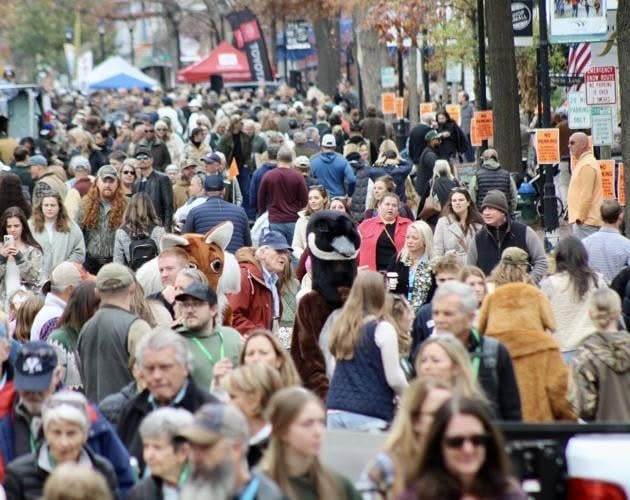
Waterfowl Festival
55th Waterfowl Festival is November 13-15, 2026, in Easton, Talbot County. Discover the best of local wildlife, nature, art, heritage, food, and FUN at the annual Waterfowl Festival. Over a dozen venues spread throughout the town entice and engage visitors to explore the area and be a part of a tradition that has been going strong for generations.
Info
FEATURED PARTNER
Attraction Magazine: THE OFFICIAL GUIDE FOR WATERFOWL FESTIVAL
The guide will be available to an anticipated 35,000 attendees during the 3-day event, November 13-15, 2026.
Deadline for final ads and content is October 5, 2026
For rates and information, contact Debbie via email at debbie@attractionmag.com
Info

FEATURED PARTNER
SHOOT FOR SUCCESS - Chamber Sporting Clay Tournament
Join the Talbot County Chamber on Oct. 2, 2026, at The Point at Pintail for annual Shoot for Success Sporting Clays Tournament. Proceeds benefit the Talbot Chamber Foundation, Inc., initiatives that help strengthen the business community and talent pipeline.
Info
SHARE
PRINT