


The Eras of Classical Music – From the Greeks to the 21st Century
“C”? or “c”? Is there a difference when it comes to classical music? You bet your Flügelhorn* there is!
A lower case “c” refers to the entire genre of classical music; the upper case “C” refers to a specific era: the Classical era (1750 to 1810). All dates are approximate, and I use the most commonly accepted dates.
But I’m getting ahead of myself…
The four most recent eras of classical music – Baroque, Classical, Romantic, and 20th -21st Century – produced the classical music with which we are most familiar. It is, however, worthwhile to understand the earlier eras and their music. Those eras are: Greek/Roman, Medieval, and Renaissance. So let’s start there.
The Greek and Roman era extends from about 1500 BC until the fall of Rome in 476 AD. Music was an important part of the culture of ancient Rome and ancient Greece; it was found at all types of events. Music was an important part of a well-rounded education; and it was believed that music could develop the mind and soul.
Music from this period still exists. The “Hurrian Hymn No. 6” (circa 1400 BC) is the world’s earliest melody, but the oldest surviving composition is the “Seikilos Epitaph”, from the first century AD, that was engraved on an ancient marble grave marker.
Songs were a hallmark of the Medieval era (1140 – 1400). They were passed down from troubadour to troubadour, from family member to family member, and from the monks and nuns to their communities. Songs were religious and secular.
This was a time when new types of music emerged, more people became exposed to music, music notation became the standard method for preserving and passing down music, and new instruments – harps, lutes, portable organs, early flutes and string instruments, and new percussion instruments – were invented.
A fair amount of medieval music has survived to this day. For instance, “Sumer is icumen in” is a mid-13th century round by an unknown composer; “Le Jeu de Robin et de Marion”, composed by Adam de la Halle, is a song from a late-13th century French play.
The Renaissance (1400 – 1600) is a time of new music; and it also was a time of re-discovering music from the earlier eras. Music printing made it possible for more people to sing and to play instruments in and out of church. One of the most beautiful pieces of music from this era is John Dowland’s “Lachrimae Pavan” for Lute.
The Baroque era (1600 – 1750) is, I believe, when music really became a cultural force; it was an era that produced a great deal of truly splendid music. This is a time of new ideas, new styles, and new instrument sounds. Notable composers of this era include Antonio Vivaldi, Johann Sebastian Bach, George Frideric Handel, and Domenico Scarlatti. It is a Vivaldi piece written in 1718, “The Four Seasons”, that truly represents this era. It has influenced and inspired many composers.
And then there’s the Classical era (1750 – 1830). Music during this period was very charming, poised, and cosmopolitan; composers admired symmetry. This was the period that saw the development of the symphony and the invention of the forte piano. Notable composers of this period are Wolfgang Amadeus Mozart, Franz Joseph Haydn, and (early) Ludwig van Beethoven. Mozart’s “Serenade No. 13 for Strings in G Major, K. 525” (“Eine Kleine Nachtmusik”), Haydn’s “Symphony No. 94” (“The Surprise Symphony”), and Beethoven’s “Violin Sonata No. 9, Op. 47 In A Major” (“Kreutzer”) are emblematic of this era.
The Romantic era (1830 – 1920) was a fruitful time and a time of change. Music was virtuosic, chamber music was important, and the piano came into its own as a solo instrument. Some composers were very preoccupied with death, nature, and the supernatural; nationalism became apparent in many composers’ works.
Three very different composers that represent this period are Johannes Brahms, Franz Liszt, and Hector Berlioz who each contributed something enduring to the Romantic period: Brahms with his “Violin Concerto in D Major, Op. 77”, Liszt with “Un Sospiro”, and Berlioz with his “Symphonie Fantastique”.
Twentieth/21st Century music brings us to the present day. The 20th century is the time that people think of as the beginning of modern music. It was a time of great innovation in so many fields, and this culture of change and innovation affected composers. This was the beginning of film music, video game music, impressionism, expressionism, minimalism, neo-romanticism, and neoclassicism – pretty much something for everyone.
Composers such as Maurice Ravel – with his ear for jazz – and Bela Bartok – who evoked nationalism – were two distinctive composers whose works (such as Ravel’s “G Major Piano Concerto” and Bartok’s “Six Romanian Folk Songs”) introduced people to early 20th century music:
Professor Emeritus Linda Cockey of Salisbury University – a noted expert on the eras of classical music – suggested the third movement of Samuel Barber’s “Excursions” to represent the 21st century. According to Professor Cockey, “[The third movement] is from a cowboy song. And it’s just a beautiful set of variations — it’s just gorgeous, full of jazz”. A classical cowboy song? Yes!
The 21st century is a time for looking forward. What will be the future of classical music? Will it even have a future? There is more evidence than you might think that the future for classical music is bright.
People today are exposed to classical music through experiences such as video games and YouTube offerings; and there are so many new venues and performance opportunities. Enduring pieces are attracting interest; and there is, of course, the use of modern technology.
So there it is: an express trip through the eras of classical music. I hope you are inspired to listen to the music cited here and to explore the glorious classical music that has been produced through the centuries.
*A Flügelhorn is a brass instrument related to the trumpet and cornet.
<><><><><><><><><><><><><><><><><><><><>
Coming in October: Your Questions Answered
Coming in November: The (Late) Queen’s Music
Coming in December: Let’s Go on a Sleigh Ride!
You Might Also Like:
FEATURED PARTNER
Attraction Magazine: THE OFFICIAL GUIDE FOR WATERFOWL FESTIVAL
The guide will be available to an anticipated 35,000 attendees during the 3-day event, November 13-15, 2026.
Deadline for final ads and content is October 5, 2026
For rates and information, contact Debbie via email at debbie@attractionmag.com
Info

FEATURED PARTNER
SHOOT FOR SUCCESS - Chamber Sporting Clay Tournament
Join the Talbot County Chamber on Oct. 2, 2026, at The Point at Pintail for annual Shoot for Success Sporting Clays Tournament. Proceeds benefit the Talbot Chamber Foundation, Inc., initiatives that help strengthen the business community and talent pipeline.
Info
FEATURED PARTNER
Waterfowl Festival
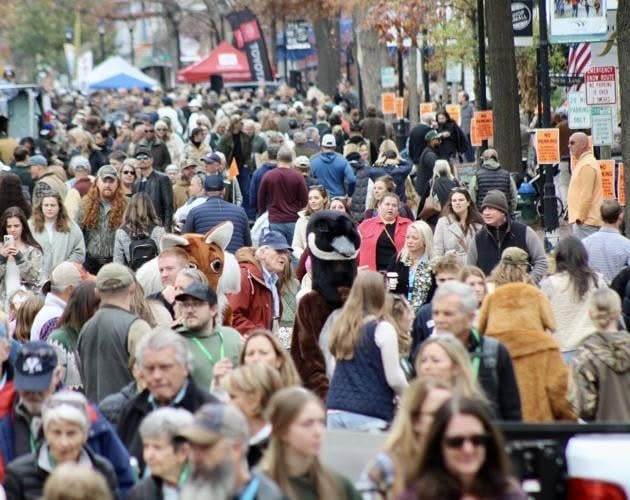
55th Waterfowl Festival is November 13-15, 2026, in Easton, Talbot County. Discover the best of local wildlife, nature, art, heritage, food, and FUN at the annual Waterfowl Festival. Over a dozen venues spread throughout the town entice and engage visitors to explore the area and be a part of a tradition that has been going strong for generations.
Info
SHARE
PRINT